
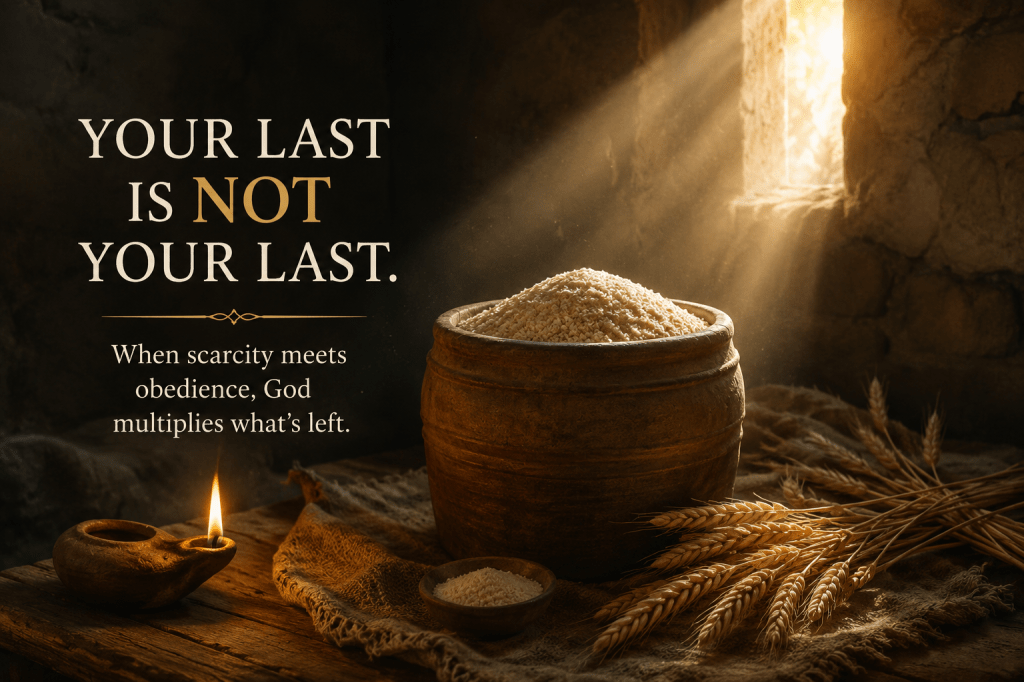
A Conversations to Clarity reflection on Job, the Widow of Zarephath, and the sustaining power of God
When the End Feels Like the End
Two women in Scripture stood at what looked like the end of everything. Both watched their world collapse. Both faced a moment where death seemed not just possible, but reasonable. And both of them spoke words that have echoed through generations — words about dying.
One said curse God and die.
The other said we will eat it, and die.
Same word. Same finality. Two completely different postures of the heart. And in the difference between them lives one of the most important truths Scripture offers us: your last is not your last.
Job’s Wife: The Voice of Despair
When Job sat on the ash heap, scraping his sores with a piece of broken pottery, his wife came to him with a sentence that has troubled readers for thousands of years.
“Then said his wife unto him, Dost thou still retain thine integrity? curse God, and die.” — Job 2:9 (KJV)
The grammar is an imperative. Two commands joined by a conjunction: curse and die. She is not warning him. She is not pleading with him to be careful. She is telling him that the way forward — the way out — is to abandon God and let death come.
Notice what surrounds her statement. Job has already lost his children, his livestock, his servants, and his health. He has lost everything except his wife and his integrity. And in the very next chapter, Job himself begins to lament:
“Why died I not from the womb? why did I not give up the ghost when I came out of the belly?” — Job 3:11 (KJV)
Job is at the edge. His wife sees the edge. And instead of pulling him back, she pushes. Curse God and die. In her grief, she has decided that the God who allowed this is no longer worthy of integrity. That death is preferable to faithfulness. That the end of life is the end of the story.
She represents what despair sounds like when it stops believing there is anything beyond what the eyes can see.
The Widow of Zarephath: The Voice of Surrender
Now travel from Uz to Zarephath. A famine is sweeping the land. God has spoken to Elijah:
“Arise, get thee to Zarephath, which belongeth to Zidon, and dwell there: behold, I have commanded a widow woman there to sustain thee.” — 1 Kings 17:9 (KJV)
Pause on this. Zarephath was Gentile territory — outside Israel, in the region of Sidon, the very land Jezebel came from. God sent His prophet across the border to be sustained by a woman who had nothing. The sustenance that should have come from Israel came instead from the unlikeliest place. This is the omnipotence of God: His provision is not limited by geography, nationality, or natural means.
When Elijah arrives and asks her for bread, she answers:
“As the LORD thy God liveth, I have not a cake, but an handful of meal in a barrel, and a little oil in a cruse: and, behold, I am gathering two sticks, that I may go in and dress it for me and my son, that we may eat it, and die.” — 1 Kings 17:12 (KJV)
She, too, speaks of dying. But listen to the difference. She is not cursing God. She is not telling Elijah to abandon his integrity. She is preparing one final meal — and she is still gathering, still cooking, still serving her child, still acknowledging “the LORD thy God liveth.” Her last is a posture of obedience even unto death.
And what happens next is the entire point:
“And she went and did according to the saying of Elijah: and she, and he, and her house, did eat many days. And the barrel of meal wasted not, neither did the cruse of oil fail, according to the word of the LORD.” — 1 Kings 17:15-16 (KJV)
Her last meal was not her last meal. Her household was sustained through the entire famine. The prophet of God was fed at her table. What looked like the end became the beginning of a miracle that history has remembered for nearly three thousand years.
Her last became her legacy.
Joseph: The Pit That Became a Palace
Joseph knew what it was to lose everything. His brothers — the people who should have loved him — stripped him, threw him into a pit, and sold him into slavery.
“And they took him, and cast him into a pit: and the pit was empty, there was no water in it.” — Genesis 37:24 (KJV)
An empty pit. No water. No way out. As far as Joseph could see, this was the end of every dream he had ever been given. And it got worse before it got better — falsely accused, imprisoned, forgotten.
But years later, standing before the very brothers who had abandoned him, Joseph spoke one of the most powerful sentences in all of Scripture:
“But as for you, ye thought evil against me; but God meant it unto good, to bring to pass, as it is this day, to save much people alive.” — Genesis 50:20 (KJV)
The pit was not his last. The prison was not his last. What looked like the death of his calling was actually the road to the fulfillment of it. God turned his lost into legacy.
David: When You Have to Encourage Yourself
David spent years running from Saul, sleeping in caves, hiding in the wilderness. But there is one moment that captures the depth of his despair more than any other. At Ziklag, his city had been burned, his wives taken, and even his own men turned against him and spoke of stoning him.
“And David was greatly distressed; for the people spake of stoning him, because the soul of all the people was grieved, every man for his sons and for his daughters: but David encouraged himself in the LORD his God.” — 1 Samuel 30:6 (KJV)
There was no one left to encourage him. No prophet at his side. No army of supporters. Just a man who had every reason to curse God and die — and instead chose to encourage himself in the Lord.
What followed? David pursued, recovered all, and went on to become king. His last at Ziklag was not his last. It was the threshold.
This World Is Not Our Home
Here is the deeper theology threaded through every one of these stories.
Job’s wife thought death was the end. The widow of Zarephath was prepared to die, but she did so in obedience. Joseph and David endured what should have been the end. And in every case, God revealed that what we call the end is rarely God’s ending.
Scripture reminds us:
“For here have we no continuing city, but we seek one to come.” — Hebrews 13:14 (KJV)
“For our conversation is in heaven; from whence also we look for the Saviour, the Lord Jesus Christ.” — Philippians 3:20 (KJV)
This world is not our home. Our last meal, our last dollar, our last hope, our last mustard seed of faith — none of these are truly last in the eternal economy of God. To surrender to God in obedience is not to surrender to defeat. It is to step into a story bigger than the one we can see with our eyes.
The widow’s barrel did not fail. Joseph’s pit became a palace. David’s burned city became the prelude to his crown. And the believer who lays down everything in obedience to Christ does not lose — they gain a kingdom that cannot be shaken.
Your Last Is Not Your Last
If you are reading this in a season where you feel you have nothing left — where you have counted your meal and counted your oil and counted your strength and come up short — hear this clearly:
Your last is not your last.
The God who sustained a widow through famine sustains you. The God who lifted Joseph out of a pit sees you. The God who met David in Ziklag meets you. The God who allowed Job to suffer also restored Job double of what he had lost (Job 42:10).
Do not curse God and die.
Eat your last, if you must — but eat it in obedience. Cook your last meal in the name of the Lord. Plant your last seed in the soil of His promises. Because in the kingdom of God, what looks like the ending is often the beginning of a legacy.
This world is not our home. Our last is not our last. And the glory of God — even in your final moment — is still omnipotent, still sustaining, still writing a story that does not end at the grave.
“He hath made every thing beautiful in his time: also he hath set the world in their heart, so that no man can find out the work that God maketh from the beginning to the end.” — Ecclesiastes 3:11 (KJV)
He is God above all things. And your story is not over.
- If this reflection ministered to you, share it with someone walking through their “last.” And come back to Conversations to Clarity — we are always asking the harder questions, in the light of His Word.

