
There is something about the story of Jehoash that I cannot stop thinking about.
His life begins with preservation.
He should have died.
When Athaliah saw that her son Ahaziah was dead, she attempted to destroy the royal descendants and seize the throne of Judah. But one child escaped.
Jehoash.
He was taken from among the king’s sons who were being killed and hidden away.
“But Jehosheba, the daughter of king Joram, sister of Ahaziah, took Joash the son of Ahaziah, and stole him from among the king’s sons which were slain; and they hid him, even him and his nurse, in the bedchamber from Athaliah, so that he was not slain.”
2 Kings 11:2, KJV
Second Chronicles gives the same account and calls Jehosheba Jehoshabeath.
She was also the wife of Jehoiada the priest.
“And he was with them hid in the house of God six years: and Athaliah reigned over the land.”
2 Chronicles 22:12, KJV
For six years, Jehoash was hidden.
Protected.
Preserved.
And eventually, through the leadership of Jehoiada, he was brought out, crowned king, and placed upon the throne.
But the part of Jehoash’s story that has stayed with me is not simply that he was spared.
It is what happened after the man who helped preserve and guide him was gone.
Jehoash Was Surrounded by Complicated Spiritual History
Jehoash did not come from a simple family.
His father was Ahaziah, king of Judah.
His grandmother was Athaliah, who was connected directly to the house of Ahab. Athaliah had brought the wicked spiritual influence associated with Ahab’s dynasty into Judah.
Second Chronicles says of Ahaziah:
“He also walked in the ways of the house of Ahab: for his mother was his counsellor to do wickedly.”
2 Chronicles 22:3, KJV
That mother was Athaliah.
Think about the contrast surrounding young Jehoash.
On one side of his family history stood Athaliah and the influence of Ahab’s house.
On the other stood Jehoshabeath and Jehoiada, who literally participated in preserving his life and restoring the Davidic king to the throne.
Jehoash inherited a complicated history.
But Scripture does not ultimately judge him according to what his grandmother did.
It judges him according to what he did.
That distinction matters.
Our influences are powerful, but eventually we become responsible for what we do with what we have been taught.
Jehoiada Did More Than Save Jehoash’s Life
Jehoiada’s role in this story is extraordinary.
He helped protect Jehoash.
He organized the overthrow of Athaliah.
He brought out the king’s son.
He crowned him.
But then Jehoiada did something even more important.
He directed the people back toward covenant faithfulness.
“And Jehoiada made a covenant between the LORD and the king and the people, that they should be the LORD’S people; between the king also and the people.”
2 Kings 11:17, KJV
Jehoiada understood that restoring a Davidic king to the throne was not enough.
The people needed to return to the LORD.
Political restoration without spiritual restoration would not have been sufficient.
And under Jehoiada’s influence, Jehoash began well.
“All His Days Wherein Jehoiada the Priest Instructed Him”
This is the sentence that changed how I read Jehoash.
Second Kings says:
“And Jehoash did that which was right in the sight of the LORD all his days wherein Jehoiada the priest instructed him.”
2 Kings 12:2, KJV
Second Chronicles makes the same observation:
“And Joash did that which was right in the sight of the LORD all the days of Jehoiada the priest.”
2 Chronicles 24:2, KJV
That qualification is difficult to ignore.
All the days of Jehoiada.
Jehoash did right.
But Scripture specifically connects that period of righteousness with the presence and instruction of Jehoiada.
And that makes me ask a difficult question.
What happens to our faith when the person influencing our faith is no longer there?
Is It Your Conviction or Their Influence?
There are people who flourish spiritually when they are surrounded by strong believers.
When they are living with praying parents, they pray.
When they are attending church consistently, they seek God.
When they have a spiritually mature mentor, they make wise decisions.
When they are surrounded by people who take holiness seriously, they take holiness seriously.
And those influences are good.
Scripture actually tells us not to forsake fellowship with other believers.
We need godly community.
We need teachers.
We need pastors.
We need mature believers.
We need people who correct us when we cannot see ourselves clearly.
Jehoash benefited tremendously from Jehoiada.
The problem was not that Jehoash needed Jehoiada.
The question is whether the truth Jehoiada taught him ever became sufficiently rooted in Jehoash himself.
Because eventually Jehoiada died.
And what happened afterward is sobering.
When Jehoiada Died
Jehoiada lived to be 130 years old.
Scripture records that he was buried among the kings because of the good he had done.
“And they buried him in the city of David among the kings, because he had done good in Israel, both toward God, and toward his house.”
2 Chronicles 24:16, KJV
Then immediately afterward, something changed.
“Now after the death of Jehoiada came the princes of Judah, and made obeisance to the king. Then the king hearkened unto them.”
2 Chronicles 24:17, KJV
There it is again.
Influence.
Jehoiada was gone.
Other voices arrived.
And Jehoash listened.
The next verse tells us what followed:
“And they left the house of the LORD God of their fathers, and served groves and idols.”
2 Chronicles 24:18, KJV
That is a dramatic spiritual decline.
The same king who had participated in repairing the house of the LORD eventually abandoned it.
Someone Will Always Be Speaking
This may be one of the greatest lessons I see in Jehoash.
When Jehoiada was speaking, Jehoash listened to Jehoiada.
When Jehoiada died and the princes came, Jehoash listened to the princes.
Someone was always influencing him.
And that makes me examine myself.
Who am I when the godly person leaves the room?
Who am I when nobody is checking?
Who am I when the person who taught me Scripture is no longer available to correct me?
Who am I when another voice sounds more attractive?
There comes a point when borrowed conviction must become personal conviction.
You cannot live forever on your grandmother’s prayers.
Your pastor’s relationship with God cannot become yours by proximity.
Your parents’ obedience cannot substitute for your obedience.
Your friend’s discernment cannot become your discernment unless you are also learning to seek God.
Godly influence can introduce us to faithfulness.
But eventually we must know the Lord for ourselves.
He Was Spared, but Later He Did Not Spare
This may be the most heartbreaking part of the entire story.
Jehoash knew what it meant to have someone intervene for his life.
Jehoshabeath had rescued him.
Jehoiada had protected him.
He had been hidden when others were being killed.
He was a man whose life began because someone spared him.
Yet after Jehoiada’s death, God sent prophets to call Judah back.
One of them was Zechariah, the son of Jehoiada.
The Spirit of God came upon Zechariah, and he confronted the people:
“Why transgress ye the commandments of the LORD, that ye cannot prosper? because ye have forsaken the LORD, he hath also forsaken you.”
2 Chronicles 24:20, KJV
Jehoash did not receive the correction.
Instead:
“And they conspired against him, and stoned him with stones at the commandment of the king in the court of the house of the LORD.”
2 Chronicles 24:21, KJV
And then Scripture deliberately reminds us who Zechariah’s father was.
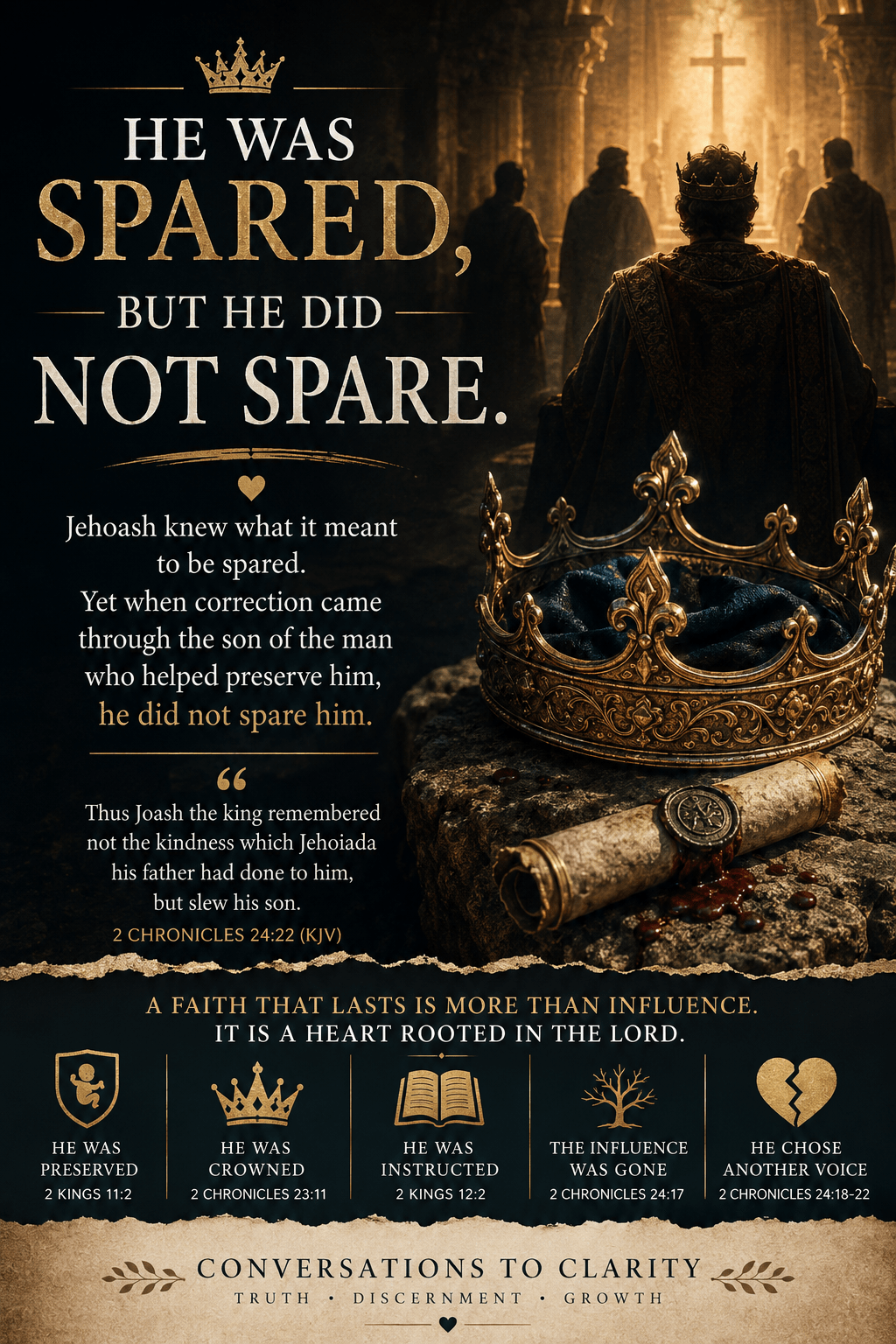
“Thus Joash the king remembered not the kindness which Jehoiada his father had done to him, but slew his son.”
2 Chronicles 24:22, KJV
That is devastating.
He remembered not the kindness.
The man whose own life had been preserved eventually commanded the death of the son of the man who had helped preserve him.
He was spared.
But later, he did not spare.
That should make us pause.
Being Preserved Is Not the Same as Persevering
Jehoash had an extraordinary beginning.
He survived a massacre.
He was hidden in the house of God.
He was raised under the influence of a faithful priest.
He became king at seven years old.
He participated in repairing the temple.
He had every appearance of an incredible testimony.
But a powerful beginning does not guarantee a faithful ending.
That may be one of the clearest differences between preservation and perseverance.
God’s mercy toward us yesterday should produce faithfulness today.
We cannot build our entire spiritual identity around what God once rescued us from while ignoring who we are becoming now.
The question is not merely:
What did God bring me out of?
The question is also:
Am I continuing with Him?
Jehoash, Jehoiachin, and Josiah
This is also why I understand why these kings started connecting in my mind.
Their stories are not identical, and we should not force them together.
But they do invite comparison.
Jehoash became king as a child and was heavily shaped by Jehoiada.
Josiah also became king as a child, but Scripture eventually describes something deeply personal in him:
“For in the eighth year of his reign, while he was yet young, he began to seek after the God of David his father.”
2 Chronicles 34:3, KJV
He began to seek.
That language matters.
Josiah received influences too, but Scripture shows us his own pursuit of God.
Jehoiachin presents a different picture again, particularly concerning judgment, captivity, and later mercy.
These men should not be flattened into one lesson.
But together they remind us that neither ancestry, position, age, environment, nor even a promising beginning tells us how someone’s story will end.
The Goal Is Not Independence From Godly Community
There is one distinction I want to make very clear.
The lesson from Jehoash is not:
“I don’t need anybody. I just need God.”
That is not biblical Christianity.
God designed His church as a body.
We are supposed to encourage one another, teach one another, worship together, receive correction, and live in fellowship.
The danger is not godly dependence upon community.
The danger is possessing a faith that exists only because someone else is maintaining it for us.
Jehoiada should influence us.
But eventually what Jehoiada teaches must become something we ourselves believe, practice, and remain faithful to before God.
When the Covering Is Gone
Eventually, every external covering changes.
Children grow up.
Mentors die.
Pastors change.
Friendships shift.
Churches change.
Seasons end.
And sometimes God allows us to discover what has actually taken root.
Was I following God?
Or was I following someone who followed God?
Was I convicted?
Or was I merely compliant?
Was I seeking the Lord?
Or was I comfortable because someone else was seeking Him beside me?
Those questions are uncomfortable.
But they lead to clarity.
Reflection
Who has had a Jehoiada-like influence in my life?
What truths have I learned from them that need to become deeply rooted convictions of my own?
Does my obedience remain when nobody is watching?
Whose voice becomes loudest when godly influence is absent?
Am I merely grateful for what God has brought me through, or is that mercy producing faithfulness in how I live now?
And perhaps most importantly:
If the person who keeps encouraging me toward God were no longer beside me tomorrow, would I still seek Him?
Closing Thought
Jehoash was hidden.
Jehoash was spared.
Jehoash was instructed.
Jehoash was crowned.
Jehoash began well.
But when Jehoiada was gone, another influence gained his ear.
That is the warning I am taking from his life.
May the people God sends into our lives teach us well.
May we honor the Jehoiadas who protect, instruct, correct, and point us toward God.
But may their faith never become a substitute for our own pursuit of Him.
Because eventually the room changes.
The voices change.
The season changes.
And when they do, may we still be found seeking the Lord.
“But without faith it is impossible to please him: for he that cometh to God must believe that he is, and that he is a rewarder of them that diligently seek him.”
Hebrews 11:6, KJV
The question is not only who helps you follow God while they are present.
The question is who you become before God when they are gone.
 Conversations to clarity