
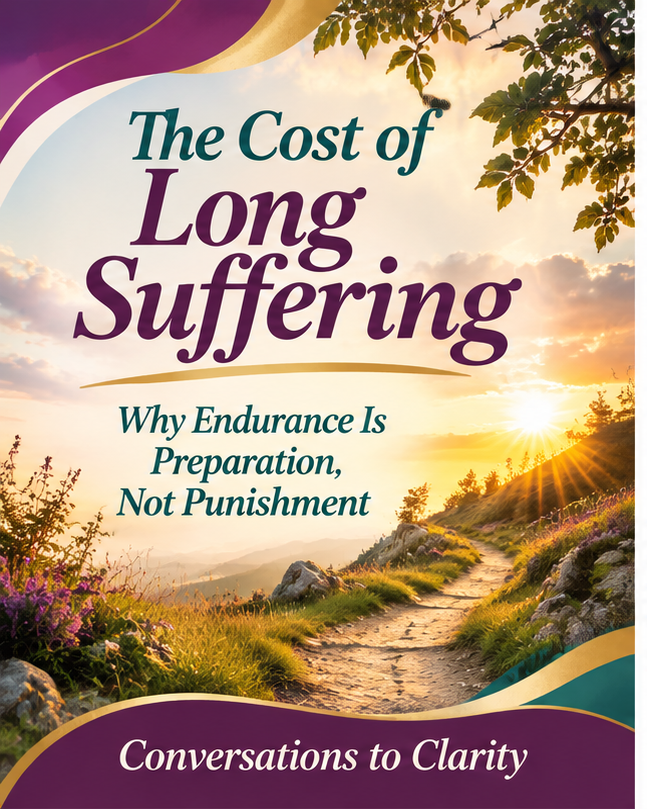
Why Endurance Is Preparation, Not Punishment
When the World Feels Heavy
I was talking to my cousin the other day about the state of the world. It is 2026, and sometimes everything feels heavy. Conflict, division, injustice, and uncertainty can leave us wondering what comes next. During that conversation, I found myself thinking about longsuffering. Why is it a fruit of the Spirit? And what can difficult seasons teach us about remaining faithful?
One thought stayed with me: perhaps some of what we learn in difficult seasons prepares us to face uncertainty with greater endurance. Not because every painful experience has been assigned to us by God, but because He can work within hardship to strengthen our faith.
Why Is Longsuffering a Fruit of the Spirit?
For years, I wrestled with that question. Love, joy, and peace sound like qualities we readily desire. But longsuffering? Did it mean that God expected us to keep suffering, or that holiness required tolerating unnecessary pain?
But the fruit of the Spirit is love, joy, peace, longsuffering, gentleness, goodness, faith, Meekness, temperance: against such there is no law. — Galatians 5:22–23, KJV
I came to understand an important distinction. Biblical longsuffering is not simply suffering for a long time. It particularly describes patience, forbearance, and being slow to anger. It is the restraint we exercise when provoked, the grace we extend when someone disappoints us, and the willingness to respond thoughtfully rather than immediately reacting.
That does not make patience easy. Relationships can test it. Disagreements can test it. But longsuffering is not God delighting in our pain. It is one of the ways His Spirit teaches us to respond with patience and love.
Endurance When Life Is Uncertain
Longsuffering and endurance through trials are related biblical teachings, but they are not identical. Scripture does not promise believers a life without difficulty. Jesus warned about troubling times, deception, and persecution. Paul wrote:
This know also, that in the last days perilous times shall come. — 2 Timothy 3:1, KJV
We should not use these warnings to identify every current event as a particular prophecy or to live in constant fear. Instead, they remind us to remain discerning and faithful. How do we respond when circumstances change, prayers seem unanswered, or the world feels unstable?
Knowing this, that the trying of your faith worketh patience. But let patience have her perfect work, that ye may be perfect and entire, wanting nothing. — James 1:3–4, KJV
James does not call trials pleasant. He teaches that tested faith can produce patience and maturity. We need not seek suffering to learn endurance; when hardship comes, we can ask God to help us remain faithful within it.
Lessons From the Wilderness
I think about Israel’s journey through the wilderness. They had been delivered from Egypt, yet their journey involved uncertainty, dependence, correction, and repeated opportunities to trust God.
And thou shalt remember all the way which the LORD thy God led thee these forty years in the wilderness, to humble thee, and to prove thee, to know what was in thine heart, whether thou wouldest keep his commandments, or no. — Deuteronomy 8:2, KJV
Their story is not permission to assume that every hardship we experience has been deliberately arranged as a personal test. But it does remind us that uncertainty can reveal what is in our hearts. Waiting may expose our impatience. Disappointment may show us where we have relied too heavily on our own control. And through those moments, we can learn to depend more fully on God.
When the World Threatens to Make Us Cold
Sometimes the hardest part of difficult times is not only what happens around us, but what begins happening within us. We can become so disappointed by people that we stop extending grace, or so overwhelmed by injustice that we lose compassion.
And because iniquity shall abound, the love of many shall wax cold. — Matthew 24:12, KJV
I do not want the state of the world to make me hardhearted. I do not want another person’s behavior to become an excuse to abandon kindness, discernment, or truth. Remaining faithful to Christ includes paying attention to the condition of our hearts.
The Cost and the Gift
Longsuffering asks us to practice restraint when we would rather react, patience when we want immediate answers, and humility when we are certain we are right. Endurance asks us to keep trusting God when we cannot control the outcome.
And not only so, but we glory in tribulations also: knowing that tribulation worketh patience; And patience, experience; and experience, hope: And hope maketh not ashamed; because the love of God is shed abroad in our hearts by the Holy Ghost which is given unto us. — Romans 5:3–5, KJV
Paul’s thought does not end with pain. It leads to hope grounded in God’s love. Hardship does not automatically make us spiritually mature, but God can use trials to deepen our dependence on Him and our compassion for others.
Patience Is Not Permission to Remain in Harm
This distinction matters. Biblical longsuffering does not require someone to tolerate abuse, exploitation, or repeated mistreatment. We can be slow to anger without being passive about wrongdoing. We can forgive without immediately restoring trust. We can seek safety, support, and accountability while continuing to walk faithfully with Christ.
There is a difference between enduring hardship and remaining unnecessarily exposed to harm. Longsuffering is a fruit of the Spirit, not a command to abandon discernment.
A Conversation to Clarity
When I think about our conversation and everything happening in the world, I return to one truth: God is faithful, even when our hearts are broken.
Loss breaks hearts. Disappointment breaks hearts. Betrayal breaks hearts. And sometimes witnessing the suffering of others leaves us grieving over circumstances we cannot change.
The LORD is nigh unto them that are of a broken heart; and saveth such as be of a contrite spirit. — Psalm 34:18, KJV
I find comfort in knowing that pain does not place us beyond God’s compassion. We can bring Him our questions and grief, ask for strength, and continue turning toward Christ even when we do not understand what is happening.
May our endurance deepen our dependence on God rather than harden our hearts. May our patience reflect the Spirit’s work without becoming an excuse to tolerate harm. And when the world feels heavy, may we remember that our hope rests not in stable circumstances, but in the faithfulness of God.
Reflection Questions
- Have I mistaken longsuffering for tolerating mistreatment?
- Where do I need more patience in my relationships?
- How can I remain compassionate when the world feels overwhelming?
- What is God teaching me about trusting Him through uncertainty?
Read. Reflect. Question. Grow.


Leave a Reply